

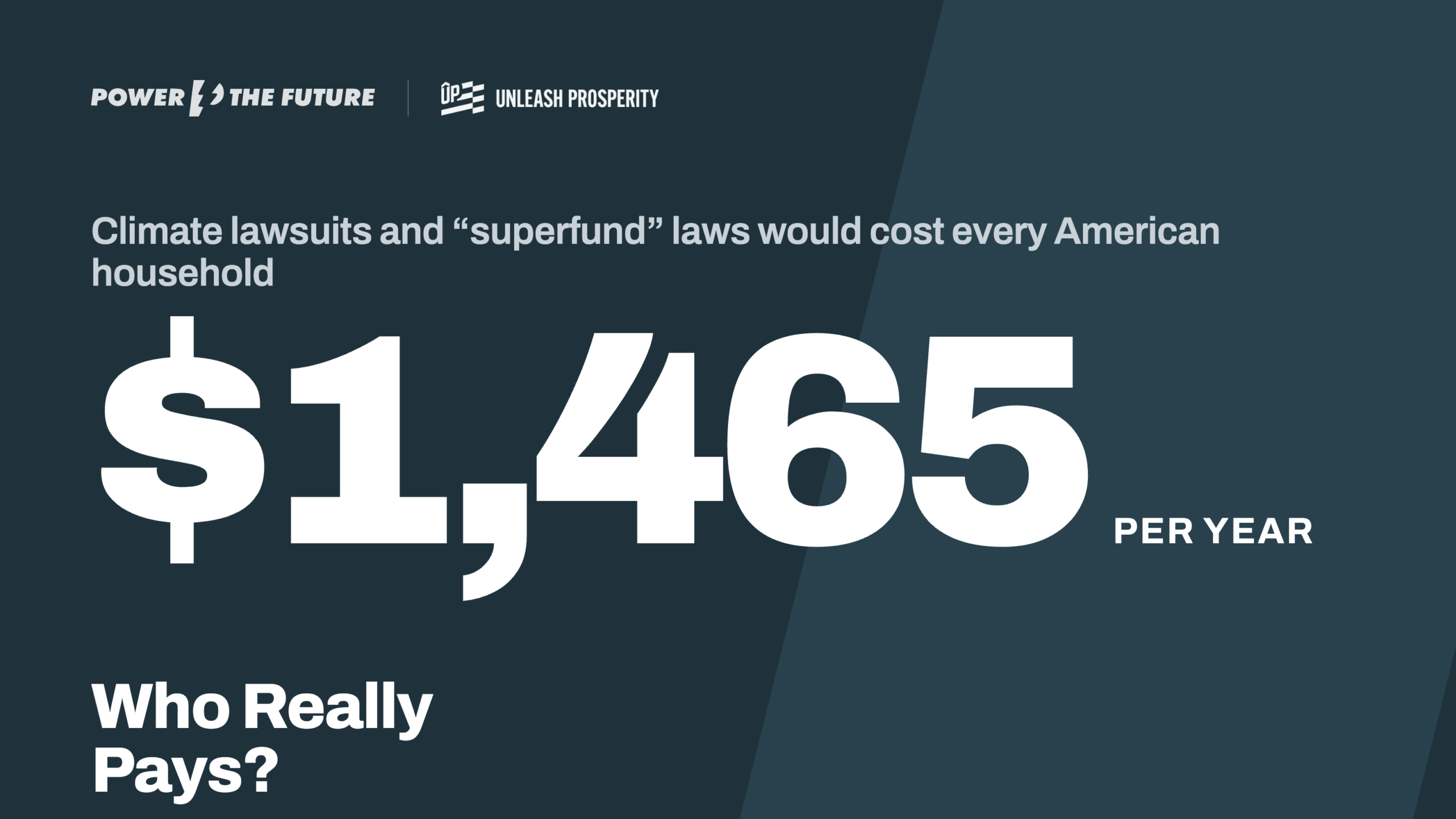
Who Really Pays?
The Consumer Cost of Climate Litigation and “Climate Superfund” Legislation in the United States
Across the country, states, municipalities, and advocacy groups are pursuing climate lawsuits and “climate superfund” policies designed to impose large new costs on energy producers. Who Really Pays?, a new report by E.J. Antoni and Power The Future’s Daniel Turner, examines what those costs could ultimately mean for American households.
The report analyzes more than 300 distinct legal controversies, enacted and proposed state climate-superfund measures, and federal legislation. Its central finding: if the measures examined succeeded on their stated terms, the resulting burden on the U.S. energy system could reach $194 billion annually, or approximately $1,465 per household each year. The report presents this as a full-success exposure scenario, not a forecast of judicial or legislative outcomes.
Key Findings
- $1,465 per household, per year in the central scenario, with a modeled range of $1,248 to $2,111.
- $194 billion in annual costs in the central case, compared with $165 billion in the low case and $280 billion in the high case.
- The central estimate translates to approximately 40.5 cents per gallon of motor fuel and 1.47 cents per kilowatt-hour of electricity.
- Even under a 50 percent pass-through assumption, the modeled burden remains $733 per household annually.
- Low-income households already spend approximately 9.1 percent of income on energy, compared with 2.4 percent for other households; roughly one in six households is behind on energy bills.
- The report catalogues 395 observations, which reduce to 311 distinct disputes after removing duplicates — a roughly 21 percent difference.
September 25, 2026